2016 Depreciation Guide
Feb 19, 2017 - In this MACRS depreciation calculator guide, we show you the steps on how to calculate your depreciation. It is the primary depreciation methods for claiming a tax deduction. 1/1/2016, Computer, $5000, 5, $480, $295.
I am a Tax Partner in WithumSmith+Brown’s National Tax Service Group and the founding father of the firm's Aspen, Colorado office. I am a CPA licensed in Colorado and New Jersey, and hold a Masters in Taxation from the University of Denver. My specialty is corporate and partnership taxation, with an emphasis on complex mergers and acquisitions structuring. W In my free time, I enjoy driving around in a van with my dog Maci, solving mysteries.
I have been known to finish the New York Times Sunday crossword puzzle in less than 7 minutes, only to go back and do it again using only synonyms. I invented wool, but am so modest I allow sheep to take the credit. Dabbling in the culinary arts, I have won every Chili Cook-Off I ever entered, and several I haven’t. Lastly, and perhaps most notably, I once sang the national anthem at a World Series baseball game, though I was not in the vicinity of the microphone at the time.
When I'm not writing about the tax law, I'm teaching exclusively for Surgent CPE. The author is a Forbes contributor. The opinions expressed are those of the writer.
When you arose from your Titos-induced slumber on the morning of January 1st, it was more than just your pants and dignity that had gone missing. While you were ringing in the New Year, the Internal Revenue Code you’d come to know and love had disappeared, replaced by the Tax Cuts and Jobs Act, the most comprehensive overhaul of the tax law in 31 years.
Fortunately for you, with enough money, both trousers and self-respect are easily recouped. An understanding of the tax law, however?
That can’t be bought. As a result, you’ve got to start over, diving into the wholesale changes that took effect on New Year’s Day in hopes of regaining the same level of comfort you enjoyed with the previous version. And that’s not going to be a quick process, because as we’re quickly learning, for every straightforward tweak to the law– the doubling of the standard deduction, the elimination of personal exemptions — there is a corresponding influx of complexity that requires you to pop on the ol’ thinking cap. United States President Donald J. Trump talks about taxes as he prepares to sign the Tax Cut and Reform Bill in the Oval Office at The White House in Washington, DC on December 22, 2017. / AFP PHOTO / Brendan Smialowski (Photo credit should read BRENDAN SMIALOWSKI/AFP/Getty Images) In last week’s Tax Geek Tuesday, we took on perhaps the most intimidating and impactful provision of the new law: the available to sole proprietors and owners of pass-through entities. It was a productive endeavor, but our work is far from over.
Today, we’ll move on to the next big challenge posed by the new law: understanding the changes that have been made to the way we depreciate assets purchased for use in a business. And while last week’s topic has garnered most of the attention, one could argue that getting our arms around the new depreciation rules could prove more difficult. After all, with the 20% of QBI deduction, the new law was all contained within one brand new provision of the Code — Section 199A. But with the depreciation rules, well.now we have to layer pieces of new law onto an already exceedingly complicated body of provisions — Sections 168(e), 168(g), 168(k), 280F and 179 to name a few — that interact with one another in ways that are hard to predict and even harder to understand.
Because we’re not tasked with simply analyzing a brand new provision, it makes sense that the best way to approach this particular Tax Geek Tuesday is to take it change-by-change, and for each discussion, lay out the law as it stood in 2017, before then looking at how the law changed yesterday morning. Changes to Depreciation Lives Current Law Way back in the 20th century, if you made an improvement to nonresidential rental property, you had to depreciate the leasehold improvement over the full 39-year life of the underlying building.
It didn’t matter if you were the lessor or the lessee, those were the rules, and so deprecation of something like a build-out of tenant space — that had virtually no chance of still being around in 39 years — nonetheless had to be depreciated over that period. Since the turn of the century, however, various incentives have been added to the Code to help speed up the depreciation process, and perhaps no asset class has benefited more from these changes than leasehold improvements. Under current law, Section 168(e)(3)(E) grants the following three classes of leasehold improvements — which would otherwise be stuck with a 39-year life – an abbreviated, 15-year depreciation period:.
qualified leasehold improvements,. qualified retail improvement property, and. qualified restaurant property. To meet the definition of a “qualified leasehold improvement,” the improvement must be:.
made to the interior portion of a nonresidential building,. made pursuant to a lease between unrelated parties, and. made more than three years after the building was first placed in service.
“Qualified retail improvements” are:. made to the interior portion of a nonresidential building,.
used in a retail trade or business of selling tangible property to the general public, and. made more than three years after the building was first placed in service. Finally, “qualified restaurant property” is:. a building or an improvement to a building, and. more than 50% of the square footage of the building is devoted to preparing or serving meals.
In late 2015, as part of the PATH extenders act, a fourth category of tax-favored leasehold improvement was added to the Code: “qualified improvement property.” There are a couple of important distinctions between qualified improvement property and qualified leasehold, restaurant and retail improvements; most importantly, unlike the latter three categories of property, qualified improvement property does not need to be made pursuant to a lease, nor must the building be at least three years old when the improvement is placed in service. Instead, the only requirements necessary to meet the definition of qualified improvement property is that the improvement be:.
made to an interior portion of a building which is nonresidential real property, and. be placed in service after the date the building is first placed in service. Qualified improvement property does not include any expenses attributable to the enlargement of the building, an elevator or escalator, or the internal structural framework of the building. These types of additions must be depreciated over the life of the underlying business.
Ex: ABC LLC finishes the construction of a building on January 1, 2016. It will lease the 3rd floor to X Co as office space. Moves in on March 1, 2016 and immediately builds out the rental space to meet their needs, spending $30,000 on cubicles, shelving, and other non-permanent additions. These improvements do NOT meet the definition of qualified leasehold, restaurant or retail improvements, because the building had not been placed in service for 3 years before the improvements were made; as a result, they cannot be depreciated over 15 years. The improvements do, however, meet the definition of “qualified improvement property,” because the improvements were made to the interior portion of nonresidential real property after the building was first placed in service. But here’s the thing: qualified improvement property that fails to also meet the definition of a qualified leasehold, retail, or restaurant improvement — like the tenant build-out in the example above — is NOT guaranteed the same shortened 15-year life afforded the latter three types of property.
Instead, under current law, qualified improvement property is stuck with the same old 39-year life as any other improvement made to nonresidential real property. So what’s the benefit of qualified improvement property if it doesn’t get the 15 year life? It is the rare type of 39-year property that is eligible for 50% bonus depreciation under current law, by virtue of Section 168(k)(2)(A)(iv).
Ex: Continuing the example above, under current law, X Co. Is entitled to claim 50% bonus depreciation in 2016, or $15,000.
The remaining $15,000 basis, however, must be depreciated over 39 years. New Law Confused? You weren’t alone.
As a result, as part of the Tax Cuts and Jobs Act, in an attempt to streamline the deprecation of leasehold improvements, after January 1, 2018, the only category left standing will be qualified improvement property. Section 168 was amended to eliminate any reference to qualified leasehold, restaurant and retail improvements. Instead, the definition of qualified improvement property was moved from Section 168(k) — the bonus depreciation subsection — to Section 168(e)(6) — the “classification of property” subsection.
The next step was supposed to be to amend Section 168 to provide a 15-year depreciation life to this condensed class of qualified improvement property. But get a load of this: that next step was never undertaken. Nowhere in the modified Section 168 does the new law actually provide a 15-year life to qualified improvement property. This is what happens when you craft law in the dead of night, minutes before a pending vote. The Tax Cuts and Jobs Act repealed qualified leasehold, restaurant, and retail improvements from Section 168(e)(3)(E) — the subparagraph that lists those assets that are entitled to a 15-year life — but never inserted into that subparagraph the new reference to qualified improvement property. It just simply isn’t there.
So as of the moment, there is nothing in the new law that actually gives qualified improvement property a 15-year life. This could become critically important, because as we’ll discuss in detail below, Section 168(k)(2) allows bonus depreciation for any property with a depreciable life of 20 years or shorter. If we can’t be certain of the depreciable life of qualified improvement property, how can we be certain it qualifies for the new 100% bonus depreciation? With qualified retail, restaurant and retail improvement property removed from the Code, the only chance we have for an accelerated expense related to leasehold improvements — whether it be bonus depreciation or Section 179 expensing — hinges on the property having a life of 20 years or less, which the new law doesn’t specifically bestow upon qualified improvement property.
This will need to be just one of what promises to be many technical corrections related to the Tax Cuts and Jobs Act. Changes To ADS Depreciation Current Law Under Section 168(g), certain assets must be depreciated using the “alternative depreciation system” (ADS).
In general, ADS depreciation requires use of the straight-line method over a longer life, meaning a taxpayer will recover the cost of an ADS asset at a slower rate than it would a “regular” MACRS asset. For example, under the current version of Section 168(g)(2)(C), both residential (27.5 year regular life) and nonresidential real property (39 years) have an ADS life of 40 years.
In addition, under the table provided at Section 168(g)(3)(B), qualified leasehold, restaurant and retail improvements (15 year life) are granted an ADS life of 39 years. Importantly, any asset that is required to be depreciated using the ADS is NOT eligible for bonus depreciation. Stick with me; this will matter in a moment. New Law The Tax Cuts and Jobs Act changed the ADS life of residential and nonresidential property under Section 168(g)(2)(C) from 39 years to 30 and 40 years, respectively. The Act then endeavored to change the ADS life of the condensed class of “qualified improvement property” (as discussed above) from 39 years to 20 years. But just as was the case with the regular depreciation life of qualified improvement property, something was lost between intention and execution, because while the ADS table at Section 168(g)(3)(B) was updated to reflect that an asset described at Section 168(e)(3)(D)(v) is afforded a 20-year ADS life, no Section 168(e)(3)(D)(v) was ever added to the Code. Yes, like a stairway to nowhere, there is another reference in the new statute that simply leads to a dead end.
To rehash, the intent of the new law was to provide a 15-year regular depreciation life and 20-year ADS life to qualified improvement property. Neither goal was accomplished, however, courtesy of some shoddy drafting.
Now, you might be asking, “Why would I possibly care about the ADS depreciation life of qualified improvement property?” And normally, I’d be right there with you. But as we’ll discuss in detail in a later Tax Geek Tuesday, a MAJOR change was made in the new law: any business with average gross receipts in excess of $25 million will be limited in its deduction for “net interest expense:” interest expense in excess of interest income. The deduction will only be allowable up to 30% of adjusted taxable income. This 30% limitation will loom large for many businesses, but one class of business can elect to avoid the interest limitation completely: those that are engaged in a “real property trade or business” under the meaning of Section 469(c)(7).
Thus, if your business is engaged in the leasing, construction, development, acquisition, operation, management or brokerage of real property (with a few more types of business allowed for by statute as well), then you can opt to avoid imposition of the 30% interest expense limitation. What’s the trade-off? If you elect out, you must depreciate your residential and nonresidential real estate, as well as your qualified improvement property, using the ADS method. So in summary, you can avoid the interest limitation, but in exchange, you’re required to depreciate your buildings and improvements over a longer time frame. In addition, you won’t be eligible to claim the new 100% bonus depreciation on the qualified improvement property because those assets will be depreciated using the ADS method. Despite these trade-offs, electing to avoid the interest expense limitation will still be well worth it for many real property trade or businesses — particularly those heavy with mortgage debt — but the fact that we don’t know what the ADS life of qualified improvements will be is a bit of a problem. Changes To Bonus Depreciation Current Law Since 2001, Section 168(k) has provided taxpayers the ability to immediately deduct a percentage of the acquisition cost of qualifying assets as “bonus depreciation.” To take bonus depreciation, the property must either:.
have a regular depreciation life of 20 years or less,. be computer software,. be water utility property, or. be qualified improvement property. (Remember, this needed to be added separately to the list of bonus-eligible assets because the previous version of qualified improvement property had a 39-year regular depreciation life, and thus would not have generally been eligible for bonus depreciation.) In addition, the original use of the property had to start with the taxpayer claiming the bonus depreciation; thus, used property did not qualify.
Finally, bonus depreciation was not permitted on any asset that was required to be depreciated using the ADS method. Bonus depreciation was always a temporary provision, and after the PATH Act was passed at the end of 2015, bonus was on its way out; the rate would have been 50% in 2017, 40% in 2018, and 30% in 2019, before disappearing completely in 2020. New Law Perhaps the most impactful change in all of the Tax Cuts and Jobs Act was to provide for 100% expensing of certain assets. Businesses love it. Economists love it. And any tax preparer who has had to navigate the interplay between the seemingly endless depreciation incentives in order to simply calculate the deduction for a given year really loves it. Understand, however, that 100% expensing is not the same as saying that a business simply gets to deduct the cost of its assets as if they were current expenses akin to a material or supply; rather, this is simply an enhanced form of bonus depreciation.
Section 168(k) was amended to provide that beginning with assets purchased after September 27, 2017 — so yes, this is RETROACTIVE to September of this year — the bonus depreciation percentage becomes 100%. Because this rule is an expansion of the bonus depreciation provisions, in order to wield the 100% expensing rules correctly, we must understand what is required in order to claim bonus depreciation under the new law. First things first: new Section 168(k) makes several important changes to the types of assets qualifying for the 100% deduction:. the reference to qualified improvement property is removed, because as discussed above, this type of property was intended to be granted a 15-year regular depreciation life, which would then fit these assets into the general requirement that they have a life of 20 years or less. Of course, as we pointed out above, the new law fails to actually give a 15-year regular depreciation life to qualified improvement property, so something will need to be done about that little gaffe.
A 100% deduction will now be available for a “qualified film or television production,” as well as a “qualified live theatrical production,” with both terms being defined under Section 181. Bonus depreciation will NOT be available to any business that has floor-plan financing (think: auto dealers), if the floor-plan financing interest is deducted in full. Bonus depreciation will NOT be available for assets acquired in the trade or business of the furnishing or sale of:. electrical energy, water, or sewage disposal services,. gas or steam through a local distribution system, or.
transportation of gas or steam by pipeline,. The asset is no longer required to be new to be eligible for 100% expensing. Used property will now qualify, as long as it is the taxpayer’s first use of the property. As with the old law, 100% expensing will not be permitted on any asset that is required to use ADS depreciation.
This has important implications for the real estate industry; remember, businesses engaged in a “real property trade or business” will be permitted to elect out of the new interest limitation rules. The give-back, however, will be that these businesses will be REQUIRED to depreciate any residential rental property, nonresidential rental property, and qualified improvement property using the ADS method, and with lives of 30 years, 40 years, and 20 years respectively. Because an electing real property trade or business will be required to use the ADS method for these three types of assets, they will not be permitted to take 100% bonus any of these assets. While this won’t prove problematic in the treatment of residential and nonresidential rental property — as these types of acquisitions were never eligible for bonus depreciation anyway, because that they have lives in excess of 20 years — it does mean that an electing real property trade or business will NOT be permitted to claim 100% bonus depreciation on any qualified improvement property. Ex: ABC LLC owns several large commercial rental properties.
Average revenue is in excess of $25 million annually, but because the properties are heavily leveraged, the LLC regularly has mortgage interest expense that exceeds 30% of its adjusted taxable income. As a result, under the new law, ABC LLC would generally be barred from deducting the net interest expense in excess of that “30% of adjusted taxable income” threshold. Under new Section 163(j), however, ABC LLC may elect to avoid the interest limitation rules, allowing the LLC to continue to deduct its net interest expense in full.
The trade-off, however, is that ABC LLC must depreciate its commercial rental buildings over an ADS life of 40 years. In addition, any improvements made by ABC LLC that meet the definition of qualified improvement property would be required to be depreciated over an ADS life of 20 years (assuming the statute is ever corrected to provide a 20-year ADS life to such assets). Even worse, because ADS depreciation of the qualified improvement property is required, those assets will NOT be eligible for 100% expensing.
Thus, before ABC LLC elects out of the interest expense limitation, it should consider the impact of the changes to its depreciation expense. There is one great unknown about this forced change of electing real estate businesses that elect out of the interest rules to using ADS depreciation: what do those businesses do with assets that are already mid-way through their depreciation schedules? The new law provide that the changes to ADS depreciation lives generally apply to assets “placed in service” after December 31, 2017. But then an additional paragraph is added to the new law, stating that for an “electing real property trade or business” that is required to use the ADS method, the change is effective “for tax years beginning after December 31, 2017.” Does this mean that an electing business that is 25 years of the way through an original 39-year depreciation schedule for nonresidential property needs to switch mid-stream to a 40 year life? The answer, unfortunately, is not clear. Also not clear is which businesses will meet the definition of a “real property trade or business.” The definition links to the real estate professional rules of Section 469(c)(7), and has been poorly defined since its addition to the law in 1993.
As I discussed in t, this will need to change, as many large businesses will be presented with the desirable opportunity to avoid the interest limitations, but only if they can meet the definition of a real property trade or business. But let’s stick a pin in this one: we’ll beat this issue up in detail in a subsequent Tax Geek Tuesday. Under Section 168(k)(6), bonus depreciation will not remain at 100% indefinitely. Instead, the break will phase out over time, like so:. 100% for any qualifying asset place in service after September 27, 2017 and before December 31, 2022,.
80% for any asset placed in service in 2023,. 60% for any asset placed in service in 2024,. 40% for any asset placed in service in 2025,. 20% for any asset placed in service in 2026, and. 0% for any asset placed in service AFTER 2026. As is the case under current law, a taxpayer will be permitted to “elect out” of the bonus deprecation regime.
Depreciation of Listed Property Current Law Certain types of assets — specifically, those that tend to blur the line between business and personal use — are subjected to limited depreciation deductions. For example, Section 280F limits the depreciation deduction on any “passenger automobile” to:. $3,160 for the 1st year,. $5,100 for the 2nd year,. $3,050 for the 3rd year,. $1,875 for each remaining year in the recovery period. The taxpayer is then entitled to deduct $1,875 each year until the auto is fully depreciated.
Under Section 168(k)(2)(F), if a taxpayer wants to take bonus depreciation on a passenger auto, the maximum amount of the depreciation allowable above is increased by $8,000; thus, the total allowable depreciation in year 1 becomes $10,650. A “passenger automobile” means any 4-wheeled vehicle that is manufactured primarily for use on public streets, roads, and highways, and which is rated at 6,000 pounds unloaded gross vehicle weight or less. It does NOT include, however:. any ambulance, hearse, or combination ambulance-hearse used by the taxpayer directly in a trade or business,.
any vehicle used by the taxpayer directly in the trade or business of transporting persons or property for compensation or hire, and. any truck or van. Because many modern SUVs weigh significantly in excess of 6,000 lbs, these types of autos will not be subject to the aforementioned limits. In addition, because the SUV is not a “passenger auto” under Section 280F, it is eligible for 50% bonus depreciation. As discussed below, however, the maximum Section 179 deduction for an SUV is $25,000. Because the order for depreciation deductions goes: Section 179 —- bonus depreciation — regular depreciation a taxpayer looking to maximize the benefits of an SUV purchased for business would do the following: Ex: Assume that in January 2017, A purchases an 8,000 lb Canyanero for use in its trade or business for $80,000.
The year 1 expense is computed as follows:. Section 179: limited to $25,000. This reduces basis to $55,000. Section 168(k): 50% bonus depreciation of $27,500. This reduces basis further to $27,500.
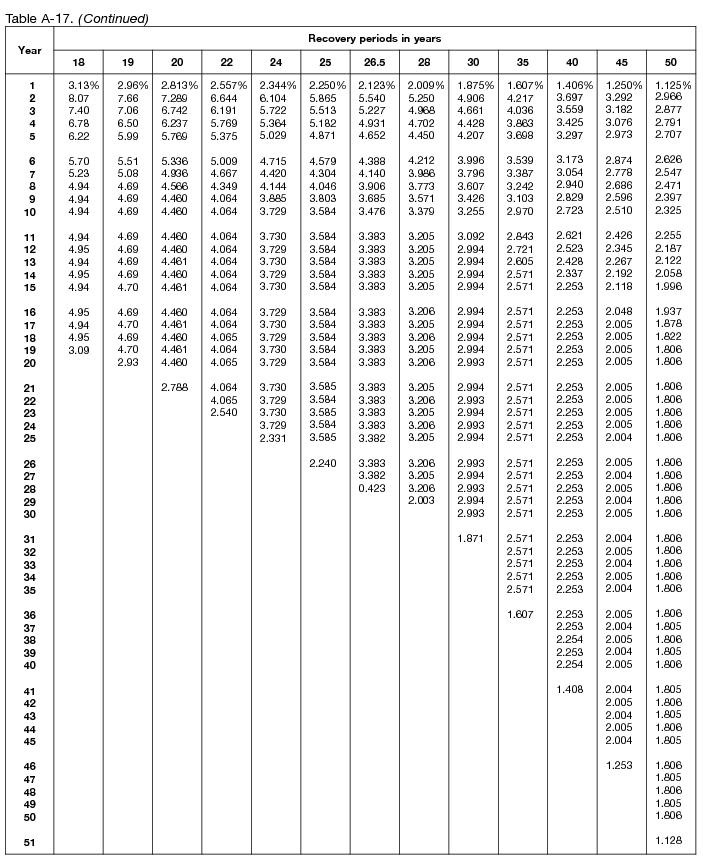
Section 168: year 1 MACRS depreciation of 20% of $27,500, or $5,500. Thus, total year 1 depreciation would be $58,000. Section 280F has been amended to increase the annual depreciation limits on passenger autos, leading to annual limits of:. $10,000 for the 1st year,. $16,000 for the 2nd year,. $9,600 for the 3rd year,. $5,760 for each remaining year in the recovery period.
The taxpayer is then entitled to deduct $5,760 each year until the auto is fully depreciated. Remember, however, that with bonus depreciation around, taxpayers are entitled to increase the otherwise applicable Section 280F limitation for year 1. After talk of doubling the increase for bonus deprecation from its current $8,000 to $16,000, Section 168(k)(2)(f) ultimately remained unchanged, meaning the maximum amount of depreciation in year 1 under the new law — when a taxpayer claims 100% bonus depreciation on a passenger automobile — is $18,000 ($10,000 + $8,000). This sounds pretty nice, no? Up to $18,000 in depreciation in Year 1 when you place a passenger auto into service?
This makes it a perfect time to plunk down $40,000 on that new set of wheels for the business, right? Not so fast, particularly if the auto weighs less than 6,000 lbs See, in each year a passenger auto is depreciated, the deduction is limited to the lesser of:.
the Section 280F limitation, or. the depreciation that would have been computed under Section 168 (normal depreciation.) So if you elect bonus depreciation on a new $60,000 auto, your deduction in year 1 would be limited to $18,000, the lesser of the Section 280F limit ($18,000) and the depreciation allowable under Section 168 of $60,000 (100% of the cost for a qualifying bonus asset). The problem arises in years 2-6, however, because in those years, the depreciation would again be limited to the lesser of:. the Section 280F limitations for each year (listed above), and. the amount allowed under Section 168, or $0.
That’s right, $0. Remember, in this hypothetical, we elected under Section 168 to apply the first year bonus depreciation rules.
So under that provision, all the allowable depreciation is taken in year 1, with nothing remaining for subsequent years. The fact that Section 280F limits the year 1 depreciation has no bearing on what the depreciation would be for years 2-6 would be under the normal rules. As a result, in those years, you would receive no depreciation deduction, before finally depreciating the entire remaining basis of the car in year 7 under Section 280F’s catch-up rule. Now this deal’s not looking so great, is it? For your $60,000 purchase, you get an $18,000 depreciation deduction in year 1, then nothing until year 7. At the tail end of 2010 — the last time we had 100% bonus depreciation — the IRS confirmed this unexpected result in Rev.
2011-21 by providing the following example: If a calendar-year taxpayer places in service in December 2010 a passenger automobile that cost $20,000, is not a truck or van, and is eligible for the 100-percent additional first year depreciation deduction, the 100-percent additional first year depreciation deduction for this property is limited to $11,060 (the limit in place at that time) under Section 280F(a)(1)(A)(i), and the excess amount of $8,940 is recovered by the taxpayer beginning in taxable year 2016. After acknowledging these bizarre consequences, the IRS offered up a safe harbor for determining depreciation in years 2-6 in that same Rev.
Proc., which is about as easy to follow as Chinese arithmetic. It works as follows (all Section 280F limitations are presented as they were in 2011): For the following steps, assume a $20,000 passenger auto placed in service during 2010, depreciable over 5 years MACRS. In year 1, you deduct the lesser of your cost ($20,000) or the Section 280F first year depreciation limit ($11,060 in our example above), or $11,060. In year 2, you must determine your remaining depreciable basis as if you took the 50% bonus depreciation, rather than the 100% bonus depreciation, in year 1. This depreciation would be $12,000 in our example (50%.
$20,000 cost =$10,000, plus first year MACRS depreciation of 20% of the remaining $10,000 basis.) And your remaining basis would be $8,000 ($12,000 – $8,000). You then subtract from the amount determined in Step 2 the depreciation actually taken in Step 1 ($12,000-$11,060=$940.) This result, if positive, is not deductible until the year after the MACRS period expires, or 2016 in our example. The remaining undepreciated basis of $8,000 is depreciated as if the taxpayer took the 50% depreciation in year 1 instead of 100% depreciation.
So in years 2-6, the depreciation is equal to the lesser of the MACRS depreciation (32%.$10,000=$3,200 for year 2) or the Section 280F limit in place ($4,900 for year 2), or $3,200. In the event any basis remains undepreciated after the end of the MACRS recovery period because of the Section 280F limitations, it would be recovered in year 7, along with the amount from Step 3. If we are to assume that the same problem — and same solution — arise anew with the 2017 version of 100% expensing, it would presumably work as follows: Assume X Co. Purchases and places in service a $60,000 passenger auto in January 2018. In year 1, depreciation is limited to the lesser of cost ($60,000), or the maximum amount of depreciation allowable under Section 280F ($10,000 + $8,000) =$18,000. In year 2, we must determine the depreciation in year 1 as if the auto were subject to 50% bonus depreciation: this would be $36,000 ($30,000 bonus depreciation plus 20% of the remaining $30,000 basis).
Then, we subtract from $36,000 the amount claimed as depreciation under Step 1, or $18,000, giving us an $18,000 balance that cannot be deducted until 2024, the year after the recovery period is over. The remaining basis of $30,000 ($60,000 – $30,000 bonus depreciation) is depreciated as if X Co. Took 50% bonus depreciation in year 1 instead of 100% depreciation. So in 2019, X Co. Would the LESSER OF:.
Depreciation Guide 2016 Ato
32% of $30,000, or $9,600, or. the Section 280F limitation for year 2 of $16,000.
This pattern would repeat itself for the next four years in the recovery period, with any remaining depreciation, including the $18,000 amount determined in Step 3, above, deducted in 2024. It would behoove you, then, to opt instead to purchase an SUV or truck that weighs more than 6,000 lbs and thus escapes the luxury auto limits.
Because with 100% expensing back, the full cost of an SUV or truck will be IMMEDIATELY DEDUCTIBLE in year 1. Remember, it is only Section 179 that limits the first-year deduction of an SUV to $25,000; for bonus depreciation, the limit was always just the applicable percentage under Section 168(k), which had been 50%, but is now going to 100%. Thus, a taxpayer who purchases a $60,000 Canyonero in 2018 would be entitled to deduct the full cost of the SUV, while someone who purchases a vehicle weighing less than 6,000 lbs will be capped out at $18,000. Section 179 Changes Current Law Unlike bonus depreciation, which requires a taxpayer to first capitalize and then depreciate an acquired asset, Section 179 allows a taxpayer to elect to simply expense the cost of an asset without capitalizing it at all.
The benefit is limited, however, to $510,000 in 2017, with that maximum deduction reduced dollar for dollar as total qualifying assets placed in service exceed $2,030,000. The deduction is further limited to the taxable income derived from the business, with any deduction in excess of the limitation carried forward to the next year. “Section 179″ property is:.
tangible, personal property (generally, real property isn’t eligible), or. computer software, or.
upon election, qualified leasehold, restaurant or retail improvements. Which is required by purchase.
Thus, under current law, while qualified leasehold, restaurant and retail improvements are Section 179 eligible, qualified improvement property (with its 39-year life under current law) is not. Generally, Section 280F(d)(1) limits any Section 179 deduction claimed against passenger autos to the amounts allowable by Section 280F(a), so $3,160 for the first year under current law. Because an SUV is not a passenger auto, however, it is not subject to these limits; instead, Section 179(b)(5) imposes a limitation of $25,000 on SUVs under current law. New Law The Section 179 limitation will be increased to $1,000,000 for tax years beginning after 2017, with the phase-out beginning at $2,500,000 of qualifying assets placed in service.
In addition, the references to qualified leasehold, restaurant and retail improvements among qualifying Section 179 property have been removed, replaced by a reference to Section 168(e)(6), which gives birth to the now-condensed class of qualified improvement property. As a result, all leasehold improvements — provided they are made to the interior portion of nonresidential rental property AFTER the building has been placed in service — will be eligible for immediate Section 179 expensing. In addition, new Section 179 makes the following types of building improvements — which would not normally meet the definition of qualified improvement property because they are improvements made to a structural component of a building — eligible for the immediate write-off:. Roofs. Heating, ventilation, and air-conditioning property.
Fire protection and alarm systems, and. Security systems. Section 179 retains the $25,000 cap on a deduction claimed on an SUV, but remember, with 100% expensing available, taxpayers will be entitled to deduct the full cost of an SUV under Section 168(k), rendering the Section 179 play irrelevant. Summary When it comes to depreciation changes in the new tax law, the opportunity for 100% expensing rightfully garnered all of the headlines. But as the article above indicates, it was far from the only change; moving forward, tax advisors will have to get comfortable with new rules governing leasehold improvements, ADS depreciation, the luxury auto rules, and Section 179.
Hopefully this discussion started you on the right path. Follow along on Twitter, @nittiaj.
: After three consecutive months of unprecedented strength, the used vehicle market slowed in September. As a result, the J.D. Power Valuation Services Seasonally Adjusted Used Vehicle Price Index declined by 0.4 points - relative to August - to 121.6. Despite the index's small decline, it remains at its highest level since November 2015, and through September 2018, it has improved by an average of 2.5% compared to full-year 2017 results.: An increase in the number of new trucks delivered should be creating a higher volume of late-model used trucks to sell. Medium duty trucks were generally down, with lighter-GVW units once again leading the market.: Used vehicle prices in August improved relative to July and ended the month even stronger than expected.
As a result, the J.D. Power Valuation Services' Seasonally Adjusted Used Vehicle Price Index increased by 2.2 points - relative to July - to 121.9.: August market looked a lot like July. Used truck supply remains tight, with strong pricing.: The Used Vehicle Price Index rises 1 point in July. Continuing the trends observed over the past several months, the used vehicle market performed exceptionally well once again in July. July's robust performance grew the index 4.7 percentage points above the same period in 2017 and 4.8 points above January 2018's level.: A higher volume of sleeper tractors cycled through auctions in June, but demand is still outstripping supply.
Medium duty conventionals recovered ground, while cabovers were steady.: June was an especially strong month for the used vehicle market, therefore increasing the J.D. Power Valuation Services' Seasonally Adjusted Used Vehicle Price by 1.2 points-compared with May- to reach 118.2. June's above-average performance brought the index 4.1 points above June 2017, and 3.8 points above January 2018.: A higher volume of sleeper tractors cycled through auctions in June, but demand is still outstripping supply. Medium duty conventionals recovered ground, while cabovers were steady.: The used vehicle market turned in a typical performace for the May period. As a result, the J.D. Power Valuation Services' Seasonally Adjusted Used Vehicle Price Index remained flat-compared to April- at 117.0. May's performace brought the index 3.1 points above May 2017's level, and 2.5 points above where it sat in January 2018.: The predicted supply increase of Class 8 trucks had not yet come to pass as of May.
Stronger demand is absorbing any additional trucks that become available.: The used vehicle market performed well in April as prices were stronger than originally anticipated. The month's performace was strong enough to increase J.D. Power Valuation Services’ Seasonally Adjusted Used Vehicle Price Index by 1 point-compared to March-and reached 117.1.: The volume of Class 8 trades has been lower than predicted, which means pricing has been more stable than expected.: The used vehicle market performed exceptionally well in March. Wholesale prices of used vehicles up to 8 years in age increased by an average of 2.5%. While prices were expected to increase in March, the outcome was better than anticipated. As a result, the J.D.
Power Valuation Services’ Seasonally Adjusted Used Vehicle Price Index increased 0.9 points to 115.9. This increase brought the index 2.5 point above the March 2017 level.: Market mixed as first quarter closes out.
March auction performance was somewhat better than expected, while February retail pricing showed expected depreciation. Medium duty trucks were down notably.:Wholesale prices of used vehicles up to 8 years in age fell by an average of 0.2% in February.
While prices weren't quite as strong as originally anticpated, the month's performance was directionally in line with recent February results and better than February 2017's 0.9% decline. Used truck market unfolding as expected. February data showed a used truck market operating as expected. Supply continues to dictate pricing, but demand should be mildly improving. Medium duty trucks continue to recover.:Wholesale prices of used vehicles up to 8 years in age fell by an average of 0.6% in January.
The sluggish startto the new year resulted in the J.D. Power Valuation Services Seasonally Adjusted Used Vehicle Price Index declining slightly. As a result, the index fell by 0.6-points (0.5%) reaching 114.2 Class 8 market looked positive in early 2018, with December's retail pricing back up and January's auctionresults similar to December's despite limited activity. Medium duty trucks had a notably up month.:Wholesale prices of used vehicles up to 8 years in age fell by an average of 2.3% in December.
The period was weaker than normal. As a result, the J.D. Power Valuation Services’ Seasonally Adjusted Used Vehicle Price Index declined slightly.
Ultimately, the index fell by 1 point (0.9%) reaching 114.8. On an annual basis, in 2017 the index declined by 3%. compared to 2016. Class 8 trucks closed out 2017 with the auction channel looking more stable than the retail channel, although we are not typically concerned about recent depreciation in the retail sector. Medium duty trucks continued their mixed performance. Volume of the most common super tractors auctioned in December increased for the second month in a row. Pricing was again very similar month-over-month.:Wholesale prices of used vehicles up to 8 years in age fell by 4.2% in November.
November’s loss was more than anticipated, however, we expected some compensation towards the end of the year from the lift in demand and strengthening in prices associated with Hurricanes Harvey and Irma. 2017 closes out positive.
Auction volume was back up in November after a slow October, with pricing stable to slightly upwards for yet another month. The retail market is firming up. Medium duty results were mixed.:Wholesale prices of used vehicles up to 8 years in age fell by 2.2% in October. As expected, the used vehicle market remained strong in October due to lingering effects from hurricanes Harvey and Irma. Looking back over the past 5 years, losses for the period averaged a slightly higher 3.2% for the period. Auction volume was down notably in October, but pricing was nearly identical to September on average. Retail volume increased dramatically month-over-month, with little up or down movement on average.:Wholesale prices of used vehicles up to 8 years in age fell by 1.1% in September.
As expected, used vehicle prices performed exceptionally well due in large part to significant decreases in supply and increase in demand stemming from disruptions of Hurricane Harvey and Irma. Historically over the past 5 years, losses for the period averaged a larger 3.1%.
Despite regional slowdowns due to remaining effects of Hurricanes Harvey and Irma, auction volume nationwide was up moderately in September, with solid pricing. Retail selling prices dipped in August, but depreciation remains milder than last year. The medium duty market was mixed and very similar to last month.:Wholesale prices of used vehicles up to 8 years in age fell by 1.2% in August. Historically over the past 5 years, losses for the period averaged a more significant 2.2%.
As a result of the month’s performance, J.D. Power Valuation Services’ Seasonally Adjusted Used Vehicle Price Index increased, up 1.1% to 111.5. August’s increase was the largest the index has experienced since May 2016. In July, the index was down 7.5% compared to the same period in 2016, while in August the year-over-year deficit was reduced to 7%. Looking back to August 2016, the index sat 7.2 points higher at 118.7. Auction volume was up moderately in August, but pricing was largely unchanged.
2018 Depreciation Guide
Retail selling prices remain stable, with depreciation milder than last year. The medium duty market was mixed, with lighter-GVW trucks down and heavier-GVW trucks stable.:Wholesale prices of used vehicles up to 8 years in age fell by 2% in July, matching J.D. Power Valuation Services’ expectations for the month. Historically over the past 5 years, losses for the period averaged a nearly identical 2.1%.
As a result of the month’s performance, J.D. Power Valuation Services’ Seasonally Adjusted Used Vehicle Price Index fell slightly, down 0.7% to 110.4. The consistent chipping away of prices month-over-month has the index down 7.1% through July compared to the same period in 2016. Looking back at July 2016, the index sat 8.7-points higher at 119.1.
July’s Class 8 auction results showed higher prices and lower volume compared to June. Retail selling prices remained stable, with minimal depreciation.
The medium duty market generally firmed up, as lighter-GVW segments performed well.:Wholesale prices of used vehicles up to 8 years in age fell by 2.2% in June, which was in line with J.D. Power Valuation Services’ expectations for the month. Historically over the past 5 years, June losses averaged a similar 2.2%, which makes the month’s result relatively average. At the segment level, mainstream car segment losses led the industry in June. Price declines for subcompact, compact, mid-size, and large cars each fell within a close range of 3.2% to 3.4%.
June market returns to expectations. June’s Class 8 auction results were back to normal, with volume up notably and pricing down mildly compared to last month. Retail selling prices remain stable, with minimal depreciation. The medium duty market retracted moderately.: Prices of wholesale used vehicles up to 8 years in age fell by 1.9% in May, which is slightly better than the way the month has historically performed over the last 20 years.
In spite of this glimmer of positivity, the 31-day period underperformed J.D. Power Valuation Services’ expectations for the month. It appears there has been no payback for February’s abnormally weak performance. May’s disappointing results impacted monthly depreciation averages.
In the first five months of the year, 2011 model year trucks averaged 3.1% depreciation per month, 2012’s depreciated 1.1% per month, and 2013’s were essentially flat (low January pricing was negated by higher February through April pricing). A late spring/summer lull in sales volume is not unusual, and given the lack of change in any trucking-focused economic measures, we do not consider May’s results indicative of a market: Prices of wholesale used vehicles up to eight years in age fell by 1.5% in April, a figure directionally in line with J.D. Power Valuation Services’ expectations for the month. April’s performance was nearly identical to the period’s 1.4% decline recorded in 2016. Looking back over the past 3 years, April has averaged similar losses of around 1.2%. Class 8 auction pricing continues to flatten out despite higher volume. This trend suggests the market is finding a bottom.
Retail pricing still shows depreciation on par with late 2016, but we expect that channel to moderate as well. Late-model medium duty cabovers are performing well, while lighter-GVW conventionals continue to outperform their heavier counterparts.: After declining by an unexpected 1.4% in February, wholesale prices of used vehicles up to eight years old rebounded in March. While this March’s 1.6% lift in prices wasn’t quite as big as anticipated, it was directionally right in line with the period’s 2.3% average over the previous three years. As we enter the second quarter, dealers remain optimistic as new truck orders continue to strengthen and used truck volume continues to trend upward. However, March’s auction and retail results were not particularly impressive, indicating market conditions are changing gradually.: In a reversal of what typically occurs in February, wholesale prices of used vehicles up to eight years old fell substantially last month, dropping 1.6% compared to January. The drop was counter to the 1% increase expected for the month and marked just the second time in the past 20 years prices fell in February (last years’ scant 0.2% being the other instance).
The new and used truck markets are showing both anecdotal and concrete signs of improvement as spring arrives. Dealers and end users are starting to report somewhat better conditions. New truck orders have been moving in the right direction since November. Used truck sales volume has been moving incrementally upward.
Depreciation in the retail and wholesale markets generally relaxed in the fourth quarter of 2016 and early 2017, and pricing and volume at auctions in February suggested a stabilizing market.: Keeping with historic seasonal trends, wholesale prices of used vehicles up to eight years old fell slightly in January, down 0.4% versus December. While the drop was expected, it was only the fourth recorded for the month since 2003. NADA Used Car Guide’s seasonally adjusted used vehicle price index fell for the seventh straight month, dropping 0.5% from December to 114.3.
January’s index figure was also 6.5% below January 2016’s 122.3 figure. As we enter the midpoint of the first quarter, new truck orders and used truck sales volume are performing somewhat better than expected. The oversupply of used sleepers continues to dictate pricing, but demand may improve mildly now that the uncertainty of the presidential election is behind us and tax cuts and regulatory rollback are on the table.: Higher supply and escalating incentives continued to chip away used vehicle prices in December. Wholesale prices of used vehicles up to eight years old fell at an above average rate of 1.7% versus November. The drop was more than three times worse than the 0.5% loss averaged for the month from 2010 – 2014. The fall was also about a percentage point higher than the Used Car Guide’s forecast for the month. Wholesale depreciation outpaced retail in 2016, with sleeper tractors losing about 30% of their value at auction from January to December, compared to 23% through retail channels.
Trucks sold at auction in 2016 brought about 30% less money than last year, while trucks sold retail brought an estimated 13% less. Medium duty cabovers and lighter-GVW conventionals performed fairly well in 2016, while heavier-GVW conventionals lost ground year-over-year.: Wholesale prices of vehicles up to eight years in age fell by 3.3% on a monthly basis in November. In addition to taking a bigger drop than expected for the month, the decline is also more than double the 1.4% average recorded during November the past three years. The month-end result was the market’s third worst performance in 2016.
As a result, NADA Used Car Guide’s seasonally adjusted used vehicle price index fell by 0.3% to 116.3. This past month of November, wholesale depreciation continued to outpace depreciation in the retail sector. Auction volume was higher during the month, while retail volume remained similar to last year. Incoming November retail data points to moderately lower volume and pricing.: October is typically one of the softest months of the year for used vehicle prices, and this year was no exception.
Wholesale prices of vehicles up to eight years in age experienced a 3.6% decline on a monthly basis in October, matching September for the biggest drop recorded in 2016. The month’s loss matched expectations for the period, landing inside NADA Used Car Guide’s forecasted range of 3.2% to 3.7%. Compared to previous years, this October’s loss was slightly more than the previous 3-year average decline of 3.3% for the period. As a result of the month’s performance, NADA Used Car Guide’s seasonally adjusted used vehicle price index fell by 0.5% to 117.2. The retail and wholesale environments turned mildly negative in September and October, following a stable summer. Auction volume and pricing were down in October, while retail pricing dipped across the board.:Wholesale prices of vehicles up to eight years in age fell by 3.6% in September.
The month’s loss fell nearly in the middle of NADA Used Car Guide’s forecasted range of 3.3% to 3.8%. September’s month-end result was the largest decline recorded yet in 2016. Losses for the period over the previous three years averaged a similar, but slightly lesser, 3.3%. As a result of the month’s performance, NADA Used Car Guide’s seasonally adjusted used vehicle price index fell by 1% to 117.5.
The figure brings the index to its lowest level since March 2011 when it was 116.2. Auction volume increased moderately in September, but the impact to pricing was minimal. Retail pricing continues to outperform expectations, and the volume of trucks sold to end users increased dramatically month-over-month. Lower pricing may be enticing more buyers back into the marketplace.:Matching expectations for the month, wholesale prices of vehicles up to eight years in age fell by 2.6% in August. August’s month-end result was the largest decline recorded so far in 2016; losses for the period over the past three years averaged a slightly less 2.2%. As a result of the month’s performance, NADA Used Car Guide’s seasonally adjusted used vehicle price index fell by 0.4% to 118.6. The late summer has brought with it a slowdown in sales and pricing in both the wholesale and retail used commercial truck markets.
The number of sleeper tractors sold at auction dropped notably for the third month in a row. Pricing in the auction lanes and from dealer-to-dealer was moderately lower. On the retail side, pricing dipped slightly.
Depreciation continues to mildly outperform our 3% – 5% per month forecast.:Wholesale prices of vehicles up to eight years in age fell by 2.3% on a monthly basis in July, tying June for the biggest drop recorded so far in in 2016. NADA Used Car Guide’s seasonally adjusted used vehicle price index also declined, dropping by 1.1% to 118.9. Auction and dealer-to-dealer wholesale prices have been generally flat May through July, but retail prices dropped moderately in June to undo May’s upward bump.
Large groups of identical, low-priced units are increasingly common. The trend impacts our averages and market prices overall.:Essentially matching expectations for the month, wholesale prices of vehicles up to eight years in age fell by 2.4% in June compared to May.
While June’s decline was the steepest recorded so far in 2016, it was on par with the month’s performances over the past several years. As a result, NADA Used Car Guide’s seasonally adjusted used vehicle price index moved little, falling by a slight 0.2% to 119.9.
May was essentially a carbon copy of April in most segments of the market. Depreciation relaxed as buyers and sellers gained familiarity with the new normal of substantial supply and lower trade values.:Typical for the month of May, depreciation accelerated as wholesale prices of used vehicles up to eight years in age fell by 2% compared to April (or a half-percentage point more than the 1.5% drop recorded a month earlier). But while depreciation on a monthly basis was higher, May’s performance was better than expected and was an improvement over the 2.7% decline averaged over the previous four years. Class 8 auction volume remains relatively steady, well behind the second half of 2015.
Volume is shifting to one specific model, and daycabs, in general, are seeing a higher supply. Retail pricing continues to catch up to wholesale, with the market sticking to our depreciation forecast of 4 – 5% per month. The freight environment remains muted, limiting demand for new and used trucks.: NADA Used Car Guide’s seasonally adjusted used vehicle price index fell for the fifth straight month in April, dropping by 0.6% from March to 118.0. The softness exhibited over the first third of the year placed the index 4% below 2015’s four month average and dropped it to its lowest level in more than five years. While weakness over the first quarter of the year was largely universal across segments, April’s meager showing was largely due to a poor performance by cars.
Preliminary April data points to more stable Class 8 selling prices in retail, wholesale, and auction channels. Seasonal improvements combined with increased demand spurred by lower price levels are the likely factors behind the moderation. Wholesale prices of vehicles up to eight years old usually climb during March, and this past month they did so by just over 1% on a monthly basis.
The upward tick is not without converse occurrence since it was well below the 2.7% average rise recorded from 2009 – 2015. March’s tepid performance pulled NADA Used Car Guide’s seasonally adjusted used vehicle price index down by roughly 1% from February to 118.6, which is the lowest level recorded since early 2011. The first quarter of the year ended with the index down 3.6% from Q1 2015, marking the first year-over-year decline for the period since 2009’s recession induced slide. Depreciation in the retail channel is catching up to devaluation in the auction lanes. Dealers are more aggressively reducing pricing to move aging inventory.
Medium duty segments are generally outperforming 2015, with pricing stable despite higher volume. A special study looks at pricing of automated versus manual transmissions in the Class 8 sleeper segment. Wholesale used vehicle prices historically rise in February as dealers prepare for the increase in consumer demand that accompanies the onset of spring. In fact, up to this year prices had moved higher in February for 20 years straight. The streak came to an end last month, however, as wholesale prices of vehicles up to eight years in age fell by nearly 1% from January. An above average increase in late-model supply was likely partially responsible for the month’s subpar performance as auction volume of 2014 and 2015 models increased by an average of roughly 20% from January to February. While it’s normal for volume to grow over the period, the rise was four times larger than what occurred on a likemodel age basis in the two years prior.
As of this writing in early March, preliminary February retail sales data points to stable to downward pricing and volume. February auction volume was on par with the second half of 2015, and pricing was steady. Looking ahead to March data, retail results should be similar to slightly higher in volume, with pricing mildly lower. Auction volume and pricing should be similar to February. Wholesale used vehicle prices were flat in January, ticking down by just 0.1% compared to December. While the difference is small, January’s movement was slightly worse than the 0.3% rise averaged over the previous five years. As a result, NADA Used Car Guide’s seasonally adjusted used vehicle price index slipped as well, dipping by 0.3% month-over-month to 122.2.
The index stood at 125.4 last January, 2.6% above this year’s level. Download the February Used Car & Light-Duty Truck Guidelines. The volume of commercial trucks sold at the nation’s two largest no-reserve auction companies shook up the market last year, and the industry continues to adapt to this new normal. January was a very slow month for auction, wholesale, and retail sales, but February returned to high auction volume. We will continue to focus our analysis on auction trends going forward. The wholesale market closed the year on something of a down note in December as prices of used vehicles up to eight years old fell by almost 2% over the month. The fall was much steeper than the 0.5% decline averaged for the period over the previous five years and marked the weakest result for the month since 2003.
As a result, NADA Used Car Guide’s seasonally adjusted used vehicle price index fell by 1.6% from November to 122.4, and moved nearly 2% below last December’s level. To continue our 2015 review, this month we’ll look at market performance of daycabs and construction trucks in addition to sleeper tractors.